

Heavy Bag Workout Routine for Strength, Speed, and Cardio
Blog / May 14,2026
If you want one workout that genuinely covers everything, the heavy bag earns that spot. A consistent heavy bag workout routine pushes your cardiovascular system, builds full-body strength, sharpens coordination, and develops mental toughness, all within one session.
Your experience level does not matter much here. Beginners find their footing. Seasoned athletes iron out weaknesses. Either way, you lace up, go through your rounds, and come out sharper than when you walked in. This guide walks you through gear, warm-up, a complete 6-round routine, and programming tips that keep you moving forward week after week.
Why Heavy Bag Training Works?
Most people assume bag work is an arm workout. It is not, not really. A proper punch starts in your legs, loads through your hips, stabilizes through your core, and finishes through your shoulder and fist. Every part of your body contributes.
That full-body demand is exactly what makes a boxing heavy bag workout so effective for conditioning. Your heart rate jumps quickly, and the bag requires you to use almost every muscle in your body simultaneously, unlike gym equipment. When you stop, you keep burning calories for hours, because vigorous interval exercise triggers the afterburn effect. Science agrees, too, showing that boxing-style HIIT quickly improves both aerobic capacity and body composition when you stick with it.
And the gains go well past cardio:
- Shoulders, chest, core, and legs all get stronger over time
- Your hand-eye coordination and footwork naturally tighten up with repetition
- Both your aerobic and anaerobic systems get pushed and developed together
- Endorphins flood in after tough rounds, leaving you less stressed and more dialed in
- Your metabolism stays revved up for hours once the session is done
Gear You Need Before You Start
Getting started with a beginner heavy bag workout does not require a big setup. A few key items are all you need.
| Gear | Why It Matters |
| Heavy bag, hung or freestanding | Your primary training tool |
| Boxing gloves, 12 to 16 oz | Knuckle and wrist protection |
| Hand wraps | Joint support underneath the gloves |
| Timer or boxing app | Structure is what makes rounds productive |
| Clear space around the bag | Footwork is half the workout |
One thing a lot of beginners skip: wrapping their hands before the gloves go on. Get into that habit from day one. It prevents the most common wrist injuries before they ever start. Good heavy bag exercises always start with proper protection, not the punching itself.
Related Reads: Improve Your Boxing Skills with These Punching Mitts Tips
The Heavy Bag Workout Routine: 6 Rounds
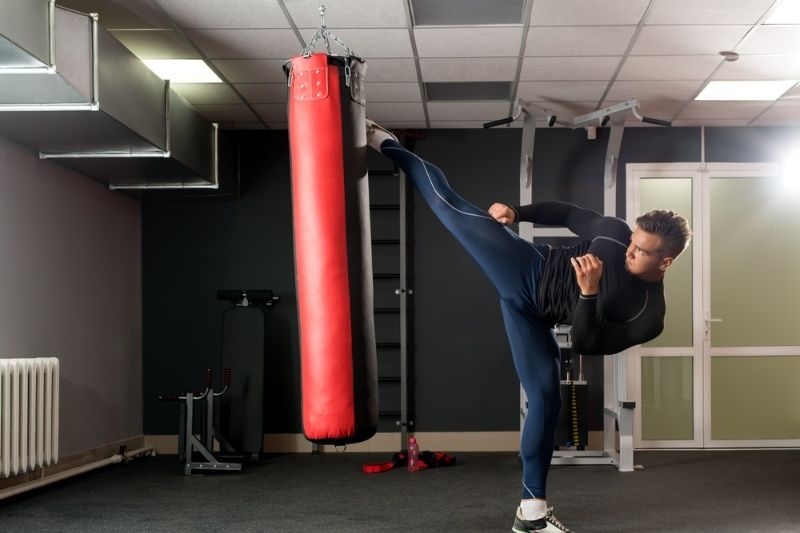
This heavy bag training routine is for cardio and power runs for 30 to 40 minutes. Each round lasts 3 minutes, with 60 seconds of rest between rounds. That work-rest structure mirrors actual boxing match pacing, which conditions your body to stay effective as fatigue builds.
Run through a proper warm-up before round one.
Warm-Up (5 to 10 Minutes):
- 2 minutes of jump rope
- Arm circles and shoulder rolls
- 2 rounds of light shadowboxing, 1 minute each
- Dynamic stretches targeting hips, calves, and shoulders
Shadowboxing is not just physical preparation. It locks your head in before you step to the bag.
Round 1: Jab Work (Speed)
Lead hand only this round. Single jabs, double jabs, jabs to the body, and jab and pivot. Stay mobile and keep your weight on the balls of your feet. Your arm should snap out and snap back. The return is just as important as the punch itself. Staying tense between shots burns your energy faster and slows your hands down.
Goal: Hand speed, range control, and accuracy.
Round 2: Combinations (Technique)
Start linking punches together. Work through jab-cross, jab-cross-hook, and cross-hook-cross. After every combination, reset your stance before launching the next one. Fully retract each punch after it lands. Letting your arm hang out there robs power from whatever comes next.
Goal: Rhythm, clean mechanics, and fluid movement.
Round 3: Power Punches (Force)
Cut the volume down and focus on impact. Hard rear crosses, hooks to the head and body, and uppercuts. Pause slightly between combinations so you can load up with intention. The power starts in your back foot, rotates through the hip, and travels up through your torso. Your arm is just the final delivery point.
Goal: Force production through hip drive and proper weight transfer.
Round 4: Defense and Counter (Fight IQ)
After every combination, slip, roll, or pivot away from the bag, like something is coming back your way. Then throw a counter before you reset. Standing flat in front of the bag and just punching builds bad habits over time. Weaving defensive movement into your heavy bag exercises is what separates a training drill from actual fight preparation.
Goal: Connecting offense and defense into one continuous flow.
Round 5: Freestyle (Rhythm and Endurance)
Pull everything from the first four rounds into one open session. Keep moving, switch up your punch selection, go hard on some exchanges, then dial back and stay precise. Sharp exhale on every punch. Holding your breath mid-combination kills your endurance faster than fatigue does.
Goal: Sustained output with instinctive decision-making as tiredness sets in.
Round 6: Burnout (Conditioning)
This is the round that honest conditioning gets built in.
- 20 seconds of nonstop straight punches
- 10 seconds of rest
- Repeat 4 to 5 times through
Your shoulders will feel heavy. Push through regardless. Speed and volume take priority over power in this round. This is the part of the session most people want to skip, and it's exactly why it matters so much.
Goal: Cardiovascular limits tested and mental toughness reinforced.
Must Read: Best Boxing Defense Drills That Every Fighter Should Know
How Often to Train?
Beginners do well with 2 to 3 sessions per week. Leave at least one full rest day in between so your wrists, shoulders, and connective tissue can recover properly.
Intermediate and advanced athletes can run 3 to 5 sessions per week. Rotate the intensity rather than going hard every single day. A heavy power session followed by a lighter speed and footwork day keeps your output quality high.
Round out your program by pairing your heavy bag training routine for cardio and power with basic bodyweight strength work and footwork drills a couple of times a week. That balance is what turns bag training into a complete fitness program.
Four Tips That Actually Work
- Stay loose between shots. Relaxed muscles are faster muscles. Tension works against you.
- Keep moving around the bag. Planting your feet during heavy bag exercises builds the same flat-footed habit in real situations, too.
- Work your weaker hand. Your non-dominant side has more room to grow, and developing it makes your dominant side sharper, too.
- Log your rounds. Write down what you finished in each session. Seeing progress on paper makes it easier to stay consistent when motivation dips.
Conclusion
The heavy bag does not lie. Every round you complete builds something real: sharper hands, stronger lungs, and a mental edge that carries well beyond the gym.
Most people never stick with a training routine long enough to see what it actually does to their bodies. You now have a structured heavy bag workout routine that removes the guesswork entirely. Six rounds. A clear purpose for each one. A progression that works whether you are just starting out or chasing your next level.
Wrap your hands, set your timer, and get through round one today. That single session puts you ahead of everyone still planning to start. Come back three times a week, and in a month, you will not recognize what your body is capable of.
Frequently Asked Questions
How long should a heavy bag workout routine be for a beginner?
Start with 20 to 30 minutes total. Include a short warm-up, 4 rounds of 2 to 3 minutes each, and a cool-down stretch afterward. Nail your form before you chase intensity. Add rounds gradually as your fitness and technique both improve together.
Can a boxing heavy bag workout support weight loss?
It can, yes. Bag training burns a solid number of calories per session and creates an afterburn effect that keeps your metabolism elevated after you finish. Pair regular sessions with a balanced diet, and you will notice consistent fat loss progress over time without it feeling like punishment.
Do I need boxing experience for a beginner heavy bag workout?
You do not need any prior experience. Begin with the jab and cross, focus on your stance, and build clean form before adding speed or power. Everything in this routine scales to your current level. Spending 10 minutes watching beginner punch mechanics tutorials before your first session gives you a much better starting point.